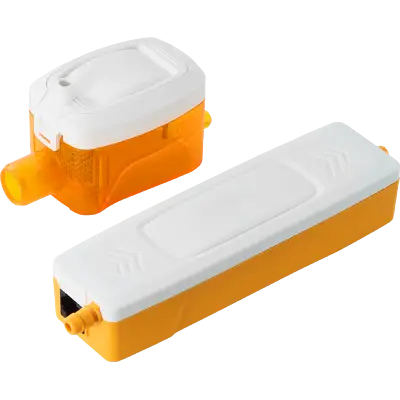
The Micro Condensate Pump For A/C is designed to efficiently remove water produced by condensation in split systems. This mini pump features a 45 ml reservoir and uses next-generation level electrodes, replacing traditional float switches. In addition, its main advantage lies in its ability to be installed within a trunking channel or inside the split unit itself, allowing seamless and concealed integration in any space.
This model, thanks to its compact dimensions and innovative design, ensures exceptionally reliable operation and very quiet performance, with a noise level below 19 dB. Dimensions: length 151 mm, width 37 mm and height 26.5 mm. Suitable for units up to 8 kW. Discharge head: up to 10 meters. Furthermore, to ensure safety and prevent overflow, it includes an audible alarm that activates when the reservoir reaches maximum capacity.
Code
4646882100
Sound level
<19 dB
Flow
24 l/h
Max. Temp.
35 ºC
Unit. Pack.
1
Gral. Pack.
20
Micro Condensate Pump For A/C in professional installations
In this case, this solution is suitable for split-type air conditioning installations where discreet condensate removal is required. Therefore, its compact format facilitates installation in confined spaces, especially where gravity drainage is not possible.
Moreover, the option to integrate it into trunking or inside the unit improves the overall installation finish. This feature is particularly useful in projects where aesthetics and reduced visual impact are important for professional installers.
Operational advantages for distribution and point of sale
For distributors, warehouses and technical hardware stores, this type of condensate pump represents a versatile product within HVAC accessory ranges. Likewise, its application in units up to 8 kW allows coverage of common professional market needs.
On the other hand, the use of level electrodes instead of a float provides a technical approach aligned with compact and reliable solutions. Additionally, the audible alarm adds a safety feature that may be relevant in installations where minimizing overflow risk is essential.